Kenya · Nairobi · Heritage and Memory
Nyayo House Torture Chambers
A government tower in the middle of Nairobi, with passport queues on the ground floor and, in the basement, the cells where Kenyans were tortured. This is the record: what was built, who was held, and why the door is still locked in 2026.
- LocationCentral Nairobi
- Completed1983
- Height26 storeys
- CellsBasement
- InterrogationFloors 24 – 26
- Public accessClosed
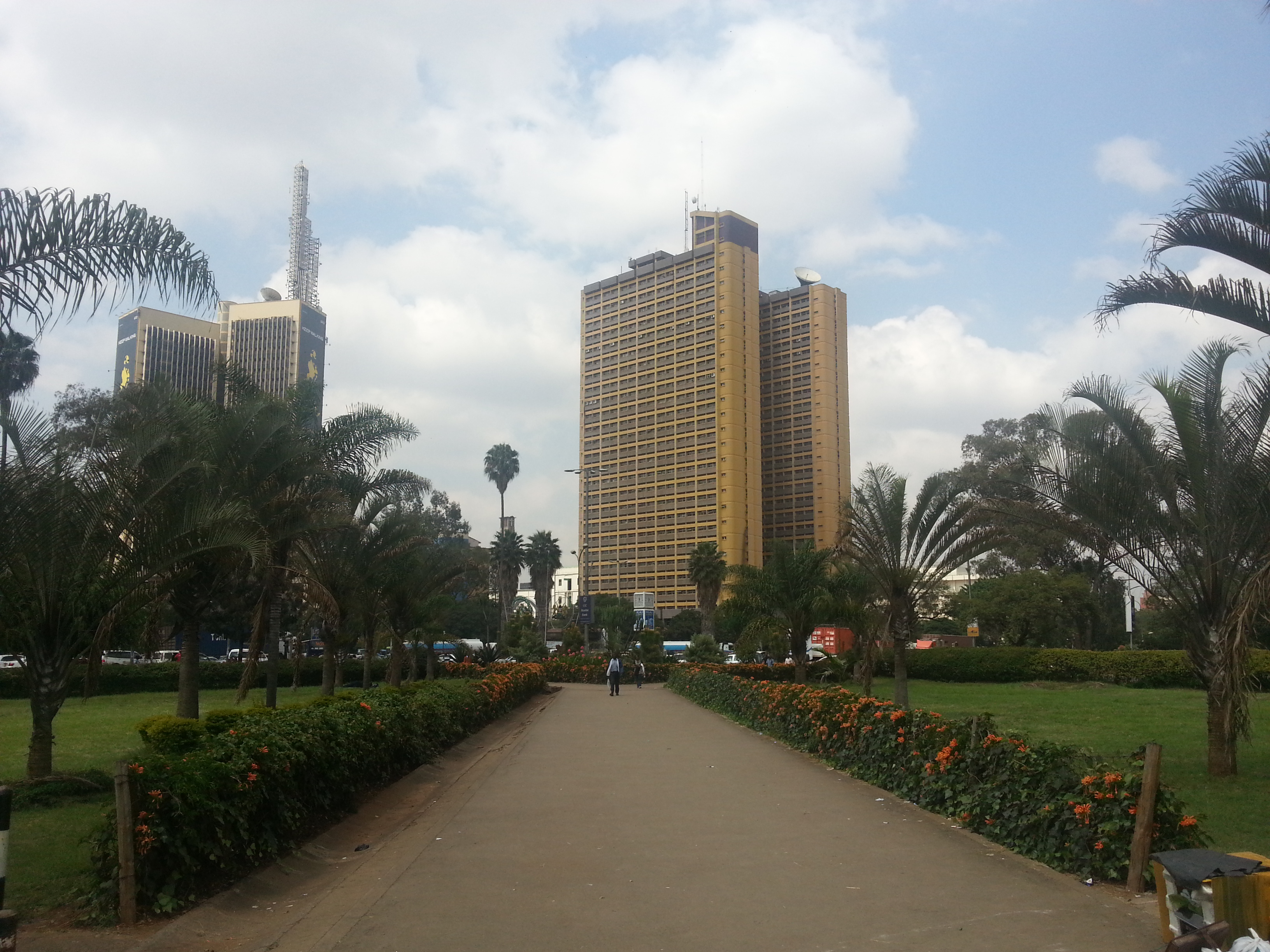
An ordinary building
Nyayo House stands on the corner of Kenyatta Avenue and Uhuru Highway in central Nairobi: twenty-six storeys of early-1980s government architecture, the kind your eye slides off. It houses immigration offices and provincial administration. Thousands of Kenyans pass through it every week on entirely ordinary business. Many of them have no idea what is underneath.
In the basement are the cells in which Kenyans were detained and tortured during the rule of Daniel arap Moi. Kenya's own Truth, Justice and Reconciliation Commission examined the site and concluded that they were purpose-built — not improvised, not repurposed storerooms, but designed as infrastructure for political violence and control.
This page exists because that record deserves to sit somewhere permanent and public, with dates and sources, while the building itself remains closed.
1982, and what followed
Moi took office in 1978 and governed for twenty-four years. His rule was marked by the centralisation of power, the narrowing of political freedom, and the use of violence as an instrument of the state.
In August 1982, a section of the Kenya Air Force attempted to overthrow him. The coup failed within hours. What followed did not: a decade of pursuing anyone suspected of disloyalty. Students and university lecturers. Lawyers. Writers and journalists. Trade unionists. Members of the clandestine Mwakenya movement, and a great many people whose only offence was proximity to someone else's conversation.
Nyayo House was completed in 1983, the year after the coup attempt. It became central to holding the country in a state of fear.
The layout, and why it matters
The arrangement of the building is part of the evidence.
The basement held the cells. Survivors describe them as dark, cramped and often waterlogged — standing water, no light, no sense of time. People were held there for days or weeks without charge.
The interrogation rooms were on floors 24, 25 and 26 — at the very top of the tower, above ordinary government offices, with the city spread out below the windows. Detainees were brought up from the basement, often in the middle of the night, subjected to physical and psychological torture to extract confessions, and taken back down.
Between those two points, on every floor in between, civil servants came to work.
The record, as far as it has been counted
107
People arrested, charged, convicted and imprisoned. Sentences ranged from four to sixteen years, and some were handed down at night.
32
People arrested, confined, tortured and jailed who died in detention or shortly after release.
13
People detained without any trial at all, including senior citizens.
58
People released without ever being charged with anything.
These figures come from the survivors' own documentation, not from a state audit. Nobody involved presents them as complete. They are what could be counted by the people who survived and by those who went looking for the ones who did not. The real totals are higher, and part of the argument for opening the chambers is that a proper accounting has never been possible.
Legal Notice No. 11 of 1991
On 1 February 1991, the Minister of State Jackson Angaine issued Legal Notice Number 11 under the Protected Areas (Amendment) Order, declaring Nyayo House a protected area. The purpose at the time was to place the building beyond scrutiny while the detentions and torture inside it continued.
That notice has never been repealed.
It is the legal instrument that governs access to the site today. Entry to the former chambers requires the permission of the Nairobi County Commissioner and the National Intelligence Service. A researcher working on the architecture of the site reported that even approval for a group of twenty participants to enter the basement met repeated obstruction from the intelligence service.
Survivors have asked, in writing and through the courts, for the notice to be repealed so that a memorial can be established. It has not been.
One open day
The chambers were opened to the public once: 18 February 2003, shortly after Moi left office. Survivors walked back down into the basement, some for the first time since they had been carried out of it. The incoming government promised them that the place would be preserved — a monument of shame, a museum of the struggle for human rights, so that the country could say never again and mean it.
There has been no unrestricted access in the twenty-three years since.
Timeline
- 1978 — Daniel arap Moi becomes President of Kenya.
- August 1982 — Attempted coup by a section of the air force fails; mass arrests follow.
- 1983 — Nyayo House is completed. The basement cells and upper-floor interrogation rooms come into use.
- Mid-1980s onward — Detentions of Mwakenya suspects, students, lecturers, lawyers, writers and trade unionists.
- 1 February 1991 — Legal Notice No. 11 declares the building a protected area.
- 2002 — Moi leaves office at the end of his term.
- 18 February 2003 — The chambers are opened to the public for the first and so far only time. A memorial is promised.
- 2008 — The Truth, Justice and Reconciliation Commission is established after the 2007–08 post-election violence.
- 2010 — Then Prime Minister Raila Odinga tours the facility and declares it should become a memorial.
- 2011 – 2013 — The TJRC hears survivors. The hearings on torture at Nyayo House are held, unusually, in the basement itself, among the broken walls and empty cells.
- 2013 — The TJRC's final report recommends converting the chambers into a public memorial and museum as symbolic reparation, with a one-year implementation deadline.
- 2014 onward — The deadline passes. Successive governments do not implement the recommendation.
- February 2020 — Moi dies, having never answered the accusations and having declined to engage with the TJRC.
- 2024 — The Kenya Human Rights Commission, the Law Society of Kenya and four survivors petition the courts for national monument status.
- 2025 – 2026 — Research published on the site records continuing access restrictions. The petition remains live; the basement remains closed.
The 2024 petition
The case was filed by the Kenya Human Rights Commission and the Law Society of Kenya together with four survivors of Nyayo House — Wachira Waheire, Florence Murage, Joseph Manje and Ngotho Kariuki — acting on behalf of other detainees and of the estates of those who did not survive.
The petition argues that survivors have a right to restorative justice and reparation, and that such reparation includes commemoration and memorials. It records that there have been attempts to destroy the chambers and conceal what happened in them. It asks the court to note that without an expedited process, the petitioners and other survivors will continue to be deprived of that right.
The petitioners are not young. That is not a rhetorical point; it is the reason the petition asks for speed.
Can you visit?
No. Not as an ordinary visitor, Kenyan or foreign. There is no ticket office, no opening hours, no tour. Entry requires written permission from the Nairobi County Commissioner and the National Intelligence Service, and such permission is rarely given, including to researchers and to survivors themselves.
The building's public functions — immigration and administration — operate normally, and you may well find yourself inside it for reasons of your own. The basement is not part of that.
Photographing government buildings and security posts in Kenya can attract attention. Exterior photography from the public street is generally unremarkable, but do not photograph entrances, guards or security installations, and do not argue if you are asked to stop.
If you want to stand somewhere in Nairobi that does confront violent death honestly, the August 7th Memorial Park, built on the site of the 1998 United States embassy bombing, is open to the public and has a museum. It is curated, staffed and maintained, a short walk from Nyayo House.
Hold the two sites next to each other, because the contrast is the entire argument of this page. Both are places in central Nairobi where people were killed. One has a museum, a visitor entrance and a guidebook. The other has a legal notice from 1991 and a locked basement. Kenya is plainly capable of memorialising atrocity. It has simply not chosen to do so for the atrocities the state committed itself.
What a memorial would take
The sequence is not complicated, and the first step costs nothing.
- Repeal Legal Notice No. 11 of 1991. It was issued to conceal a crime and survives only because nobody has struck it out. While it stands, nothing else can even be discussed.
- Gazette the chambers as a national monument, as the petition asks and as the TJRC recommended.
- Secure the fabric. The basement has deteriorated, and there have been attempts to alter it. Conservation of the cells as physical evidence has to happen before curation.
- Record the survivors, now. Oral testimony is the part of this archive with a deadline attached to it.
- Hand it to a named institution — the National Museums of Kenya or an equivalent body — with a budget line that renews annually, rather than a launch event and nothing after it.
If you were there, or you know someone who was
This page is a record, and records improve when the people who lived them add to them. If you were detained at Nyayo House, if a member of your family was, or if you hold documents, photographs or correspondence from that period, this site will publish what you send in full and unedited, or hold it confidentially if that is what you prefer.
Corrections from any source — including from Kenyan state institutions — will be published promptly and marked as corrections, with the original text left visible.
Read on
- Nyayo House — the torture chambers under Nairobi, and the 1991 decree that still keeps them shut, the companion essay on African Independence.
- Launch and Abandon — what happens to African state heritage projects after the ribbon is cut.
- Kenya's national parks — the rest of this site's Kenya coverage.
- Cape Coast Castle and Elmina Castle in Ghana — dungeons preserved and open to the public, and what that decision makes possible.
- Ghana Museums — field reports and open letters on heritage sites in Ghana.
The honest verdict
What keeps the basement of Nyayo House closed in 2026 is not Daniel arap Moi. He died in February 2020. It is an unrepealed statutory instrument from 1991, an intelligence service that controls the keys, and a recommendation from Kenya's own truth commission that three administrations have declined to act on.
A state that held hearings in a torture chamber, published a report about it, and then locked the door again is not failing to decide. It has decided. The survivors are in their seventies and eighties, and the passage of time is doing the work that no minister has had to put his name to.
Verified and fact-checked: 23 September 2026.
Sources: the final report of Kenya's Truth, Justice and Reconciliation Commission (2013) and reporting on
its findings; documentation of the Nyayo House torture chambers case published by the Kenya Human Rights
Commission, filed in 2024 with the Law Society of Kenya and four survivors; Kenyan press reporting from
2021 to 2026, including the survivors' compiled figures; and peer-reviewed research published in 2025 and
2026 on the architecture of the site and on access restrictions. Victim numbers are those documented by
survivors and are not complete totals. Individuals are named here only where they appear in the findings
of the truth commission, in court filings, or as public petitioners; no allegation is made against any
living person beyond what those records contain. This page will be revised as the court case proceeds.